
Voice search optimization in 2026 is not a trend. It’s now a core part of how people find businesses. A year ago, most users typed short phrases into Google and scrolled through results. Today they speak to their phones or smart speakers. They expect an answer. This shift has changed the way SEO works. For businesses.
I’m a freelance digital marketer based in Kochi. Watching this change unfold up close is what led me into voice search SEO. Customers aren’t searching like they used to. Instead of typing “digital marketer Kochi “, someone will ask their assistant “Who is a good digital marketer in Kochi?” That’s not a way to type. It’s a different kind of question. It requires a kind of content to answer it.
In this guide, I’ll walk through what voice search optimization means in practice. I’ll share the framework I use with clients, the mistakes I see and where things are headed next.
Why Voice Search Behaviour Has Changed with Voice Search Optimization
Voice search isn’t new, but the way people use it keeps changing. Instead of typing one or two keywords, users are increasingly speaking to search engines as if they’re talking to a person—with complete sentences, context, and location included.
For example, people may ask, “Where can I find a family restaurant near me?” or “What’s the best plumber open now?” These natural, conversational questions show why Voice Search Optimization is becoming increasingly important for businesses that want to reach customers through modern search.
This matters most for businesses. A voice query usually comes with urgency and proximity. Someone wants to act. Not read ten website links. If your site, your Google Business Profile and your local SEO details aren’t set up to answer those questions clearly, you’re invisible when it counts.
What Voice Search Optimization Looks Like for a Local Business
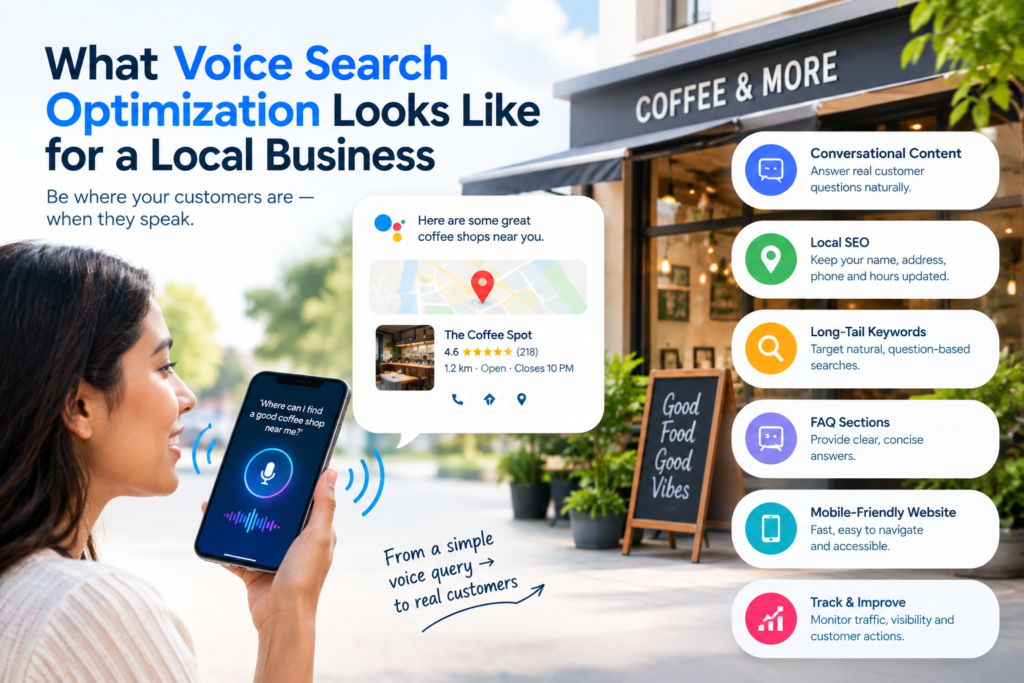
Let’s take an example: a family-run restaurant in Kochi trying to get walk-in customers. The first step isn’t picking keywords. It’s understanding the questions a hungry person might actually ask:
– Where can I find a family restaurant near me?
– What are the best restaurants open near me now?
From there optimization looks like this:
– Create clear FAQ sections that answer those exact questions in simple language
– Fully complete your Google Business Profile. Accurate category photos, updated hours
– Make sure your business name, address, phone number, services and opening hours match everywhere online
– Add location content that names neighbourhoods, landmarks or areas served
– Use structured data so search engines understand your info programmatically
– Write short answers to common questions instead of hiding them in long paragraphs
The goal isn’t to rank specifically for voice search. That idea doesn’t even work anymore. The real goal of Voice Search Optimization is to make your business easy to find and understand through both voice searches and regular local searches. Instead of chasing unverified voice-result wins, I track success through organic traffic, local visibility, impressions, and actual actions like calls, directions, or bookings.
Common Voice Search SEO Mistakes to Avoid
The mistake I see? Businesses still thinking in keywords. They optimize a page for “marketer Kochi”. Stop there. No one says that loud. Real conversations go like:
– Who is…
– What’s the best…
– Where can I find…
The fix? Build content around long-tail questions. Add FAQ sections that reflect real customer queries. Strengthen your SEO basics. Keep contact details, location, services and hours easy to find.
The second mistake? Treating voice search as something from SEO. It’s not. Voice search works best on top of content SEO. If your site loads slowly, lacks friendliness or misses local signals, no clever phrasing will help.
A Simple Framework for Voice Search Optimization
Here’s the six-step process I use with every client:
1. Identify queries. Find the questions customers actually ask. For example: “Where can I find a marketer near me?”
2. Target long-tail, question-based keywords. Move beyond terms and build content around the phrases people say.
3. Create answers. Give concise answers to common questions. Especially in FAQ sections and service pages.
4. Strengthen SEO. Keep business name, address, phone number, services, hours and Google Business Profile accurate and consistent.
5. Improve the website experience. A fast, mobile-friendly, clean site matters as much for voice as it does for regular search.
6. Improve. Track traffic, impressions, local visibility, rankings and engagement. Then update your content based on what customers are really asking.
The core idea behind all six steps? Write the way people talk. Answer the questions they actually ask. Make your information easy for search engines to understand.
Where Voice Search Is Headed Next
I believe voice search is moving toward a more exciting, conversation-driven, action-focused experience. People won’t just ask one question and stop. They’ll keep using voice assistants to compare options, discover businesses, and finish tasks—not just grab facts.
Google’s AI-powered search already handles complex questions. That trend isn’t slowing down. For businesses who want to prepare the advice stays the same:
– Create content that answers customer questions in natural language
– Strengthen local SEO signals
– Keep business info accurate across all platforms
– Make your site mobile-friendly
– Build clear FAQ and service pages
It also helps to think of Voice Search Optimization as part of a broader strategy, not a separate channel competing for attention. Answer Engine Optimization (AEO) is becoming increasingly important. Google has made it clear that structured, organised content that directly answers user questions can be surfaced and summarised by its systems. That aligns closely with what effective Voice Search Optimization has always required.
Frequently Asked Questions
**What is voice search optimization?**
It’s the process of setting up your website content, local business info and technical structure so search engines can easily understand and show your business when people speak questions into assistants or voice-enabled devices.
**Is voice search optimization different from SEO?**
Not completely. It builds on SEO. Puts more focus on conversational long-tail keywords FAQ content and local signals like a fully filled-out Google Business Profile.
**How do I optimize my Google Business Profile for voice search?**
Keep your business category, hours, address, phone number and services correct and up-to-date. Add photos regularly. Make sure the information matches your website exactly.
**Do I need content for voice search?**
No. You don’t need content. Just structure it differently. FAQ sections, short answer blocks and clear headings work well for both humans and voice assistants pulling answers.
Key Takeaway
The businesses succeeding with Voice Search Optimization aren’t building a completely separate strategy. They’re doing SEO, with a sharper focus on how real customers talk out loud. Start by listing the questions your customers ask. Answer them clearly in your content and keep your business details accurate. That’s the foundation everything else depends on.