
This is not a list of marketing trends in 2026 that I took from a press release. This is what is actually happening inside customer accounts. I am talking about AI in Digital Marketing 2026
The Real Change in AI in Digital Marketing 2026: From Creating Content to Speeding Up Workflows
The biggest change is not that artificial intelligence “does the marketing.” The biggest change is that artificial intelligence has moved from content generation into workflow acceleration and decision support. Instead of spending hours looking at a blank page, marketers are now using artificial intelligence to make things faster. For example, AI in Digital Marketing 2026
* Make blog posts, email campaigns, social posts and ad copy from one content brief in minutes
* Look at campaign performance. Find trends much faster than manual reports
* Create many versions of ad creative for testing
* Make keyword research, content grouping and SEO optimization faster
* Create personalized email and ad messages for different groups of people
The daily work of marketers has changed from creating everything from scratch to checking, improving, ensuring accuracy, and making strategic decisions. In AI in Digital Marketing 2026, human thinking still drives the brand voice, customer understanding, creativity, and business goals. Artificial intelligence simply takes over more of the execution and first-draft work, while marketers remain responsible for the final direction and decisions.
This matches what the industry as a whole is seeing. Now 90 percent of marketing teams are using intelligence in 2026. Most of that use is in exactly these areas. Content creation and SEO workflows are where teams say they have the most measurable improvements.
Real Example: How One Local Services Client Doubled Content Output
Here is what that change looked like in practice with a home service client. Before using intelligence in the process the team was making one blog post every two weeks. Not because they had no ideas. Because the process itself was slow.
The team had to do the tasks:
Task Time
Keyword research took about 2 hours
Content outline took about 1 hour
First draft took about 4 hours
Total per article took about 7 hours
After artificial intelligence was added to the process, the way things worked changed. In AI in Digital Marketing 2026, artificial intelligence can create keyword groups, develop content outlines, and produce a first draft. The marketer then checks that the information is accurate, adds local knowledge, improves the content for search engines, and adapts it to match the brand’s voice and goals.
The result was that the time to make each post dropped to about 2–3 hours.. The team went from making two posts a month to one post every week.
The important thing is not that artificial intelligence created “content.” The marketers fixes were what made it ready to publish. What artificial intelligence did was give the marketer time to focus on strategy, quality and improvement instead of typing out a first draft from a blank page.
Common Errors Marketers Make With Artificial Intelligence in 2026
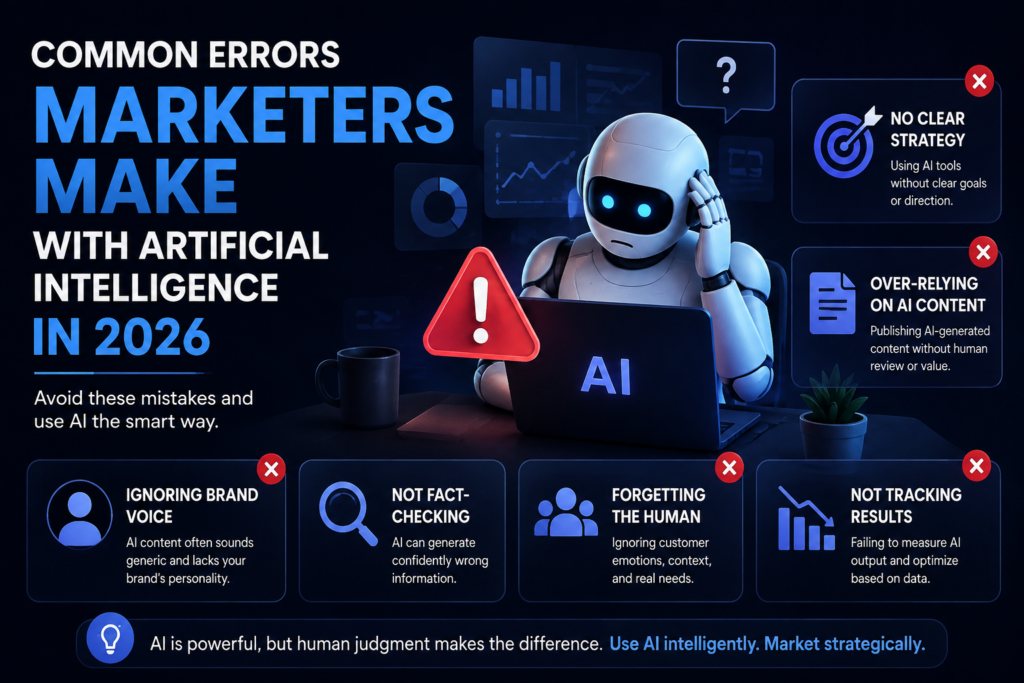
Not every team is doing this correctly. One of the errors is seeing artificial intelligence as a replacement for knowledge instead of a tool for working faster.
Here’s a shorter, more natural version with the keyword included:
A common pattern is simple: teams use AI to create blog posts, ad copy, or landing pages, make minimal edits, and publish quickly. But faster content doesn’t always mean better results.
With AI in Digital Marketing 2026, producing content is easier than ever, but creating content that feels original and useful is still a challenge. Overusing AI can lead to generic content, outdated information, brand-voice issues, and weak customer value.
AI can save time, but real experience, creativity, and human thinking still matter.
Another common mistake in AI Digital Marketing 2026 is focusing on how much content you can produce instead of how useful it actually is. Creating 50 AI-generated posts is unlikely to be better than 10 well-researched pieces with real examples, expert opinions, and genuinely helpful information.
The marketers who get the outcomes use intelligence to make research, brainstorming, first drafts, outlines, ad and email variations and performance reports faster. While keeping ideas, facts, messages for specific people and big decisions in human hands.
A Useful Way to Decide: What to Give to Artificial Intelligence and What to Keep for People
One of the tools for this choice is a basic three-tier system. Call it the Artificial Intelligence and Human system.
🟢 In AI in Digital Marketing in 2026, let artificial intelligence handle tasks that are repetitive, structured, or data-heavy. This can include keyword research, topic grouping, content outlines, first drafts, meta titles and descriptions, social caption variations, ad headline ideas, performance reports, and competitor research summaries.
A simple question to ask is: “Is this task repetitive or does it take a lot of time?” If yes, AI can probably help.
🟡 In AI in Digital Marketing 2026, humans and artificial intelligence work best together when AI creates a first version and a marketer improves it with human expertise. This can include blog posts, landing pages, email campaigns, Google Ads copy, SEO improvements, content updates, and customer profiles. Before using AI-generated work, ask: Will human knowledge make this better? If yes, human input should remain an important part of the process.
🔴 In AI in Digital Marketing 2026, keep human involvement at the center of marketing plans, brand positioning, customer interviews, final checks before publishing, money spending, problem-solving, client relationships, and creative ideas designed to make your brand stand out. Always ask: Could a mistake here hurt trust, damage the brand image, or cost money? If the answer is yes, keep a human in control.
A simple four-step list makes it easier to use in the moment:
1. Is the task repeated? → Use intelligence.
2. Does it need creativity or business thinking? → Human leads.
3. Could mistakes cost money? → Human checks.
4. Would the customer notice if this felt the same as others? → Add a touch.
The main idea is that artificial intelligence should make work faster. People should control plans, ideas and responsibility.
Where Artificial Intelligence Marketing Trends 2026 Are Going: AI in Digital Marketing 2026
Here is a prediction worth thinking about: the advantage is moving from who uses intelligence to who has the best marketing systems.
Now, most marketers have access to artificial intelligence tools. As these tools become more advanced and widely used, simply using AI is no longer a competitive advantage. In AI in Digital Marketing 2026, what matters is how effectively a business combines artificial intelligence with its own data, workflows, industry knowledge, and experience to create better marketing results.
Imagine two agencies using the artificial intelligence model. Agency A asks it to “write a Google Ads campaign.” Agency B gives it customer profiles, past campaign results, brand rules, best landing pages and conversion numbers before anything is made. The artificial intelligence is the same. The quality of the system around it is what makes the results better.
Expect the marketer’s job to keep moving from simply creating content toward designing better ways of working, analyzing AI in Digital Marketing 2026 results, understanding customer data, and testing new ideas. The most important skill will not be writing the perfect AI prompt. It will be creating effective workflows where artificial intelligence consistently supports better marketing decisions.
This is an opinion, not a promise. AI in Digital Marketing 2026 is evolving quickly as artificial intelligence tools, search platforms, advertising systems, and customer behavior continue to change. Companies that focus on their expertise, understand their customers, and build reliable workflows are more likely to succeed than those simply producing more AI-generated content.
FAQ
Is intelligence replacing digital marketers in 2026? No. The signs show that artificial intelligence is replacing certain tasks, but not the job itself. In AI in Digital Marketing 2026, the marketer’s role is shifting toward strategy, quality checking, creative thinking, and making important decisions. The future belongs to marketers who know how to combine artificial intelligence with human expertise.
What are the best artificial intelligence tools for marketers now? The teams that do best focus on systems. Giving intelligence their own customer data, brand rules and past results so the results are specific not generic.
What is the biggest danger of using artificial intelligence in digital marketing? In AI in Digital Marketing 2026, one of the biggest risks is publishing AI-generated content without enough human review. It can produce content that sounds similar to what everyone else is publishing, misses the brand voice, contains inaccurate facts, and fails to provide real value to customers. Human oversight is essential to ensure AI-generated content is accurate, useful, original, and aligned with the brand.
AI in Digital Marketing 2026
AI in Digital Marketing 2026 is not about who gets the tools first—almost everyone has access to them now. It is about who builds better workflows, strong data checks, and human review processes that turn generic AI results into meaningful marketing.
If you’re looking for a digital marketing service in Kochi, start by reviewing your current workflow. Be honest about where you are relying too much on AI without enough human checking, strategy, or creativity.